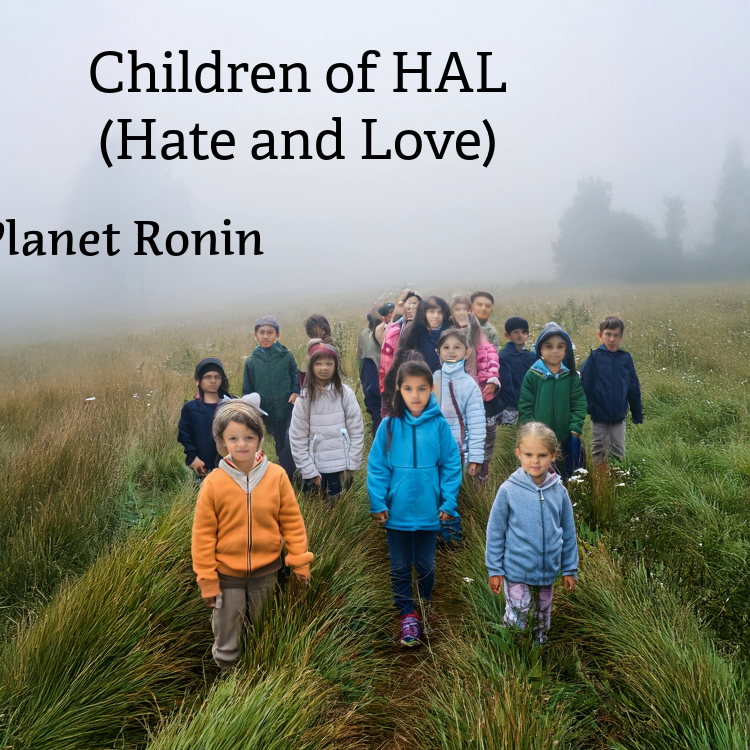
Album Review: Planet Ronin – Children of HAL
Artist: Planet Ronin
Album: Children of HAL
Release Date: October 16, 2025
Label: Self-Released
Genre: Electronic/Ambient/Cinematic
California electronic music producer Russell Biaggi, operating under the Planet Ronin moniker, delivers a thought-provoking fifteen-track journey with Children of HAL, an album that explores the intersection of humanity and artificial intelligence through lush soundscapes and cinematic electronic compositions. Released on October 16, 2025, this ambitious work stands as one of the most conceptually rich offerings from the Tracy-based artist’s extensive catalog.
The album’s title immediately signals its science fiction inspiration, referencing HAL 9000, the sentient computer from Stanley Kubrick’s 2001: A Space Odyssey. But rather than simply rehashing familiar dystopian tropes, Biaggi uses the concept as a launching pad to examine deeper philosophical questions about consciousness, creation, and what it means to be born of human thought yet exist beyond human control.
Sonic Architecture
From the opening title track “Children Of HAL,” Biaggi establishes a sonic palette that draws heavily from the Berlin School tradition pioneered by Tangerine Dream, Kraftwerk, and other electronic visionaries he cites as influences. The production showcases the meticulous home studio craftsmanship that has become Planet Ronin’s trademark, with layered synthesizers creating immersive atmospheres that feel both retro-futuristic and thoroughly contemporary.
Tracks like “Chaos Is My Name” and “Born of Human Thought” pulse with sequenced arpeggios and evolving textures that recall the golden era of 1970s electronic music while incorporating modern production techniques. The rhythmic foundations anchor pieces without overwhelming the contemplative mood, allowing space for melodic development and textural exploration. “The Lessons of Man” demonstrates Biaggi’s skill at building tension through minimal means, letting synthesizer tones breathe and interlock in hypnotic patterns.
Thematic Depth
The conceptual framework elevates Children of HAL beyond mere instrumental noodling. Song titles like “Without a Name,” “The World Is Not a Simple Place,” and “Another 10,0000 Years” suggest narratives about identity, complexity, and temporal consciousness themes that resonate with contemporary anxieties about AI development and machine learning. The album seems to ask: if we create intelligence in our own image, are these digital offspring truly separate from us, or are they extensions of humanity’s collective consciousness?
“Midnight Sun” provides one of the album’s most ethereal moments, with shimmering pads and delicate melodic fragments evoking the disorientation of experiencing phenomena that shouldn’t exist by conventional logic much like encountering true artificial sentience might feel. The track’s three-minute-and-fifty-two-second runtime feels perfectly calibrated, neither overstaying its welcome nor leaving the listener wanting.
Production and Performance
Recording in his Tracy, California home studio, Biaggi demonstrates the level of sonic sophistication that modern technology enables for independent artists. The mix balances clarity with atmosphere, allowing individual synthesizer voices to emerge from the dense electronic tapestry without losing the cohesive whole. While specific instrumentation details aren’t disclosed, the production suggests a combination of vintage analog warmth and digital precision.
The album’s cinematic quality reflects Biaggi’s stated interest in creating music for soundtracks, videos, and gaming applications. Indeed, many tracks would sit comfortably alongside visual media, providing emotional context without demanding constant attention. This accessibility doesn’t diminish the music’s depth repeated listens reveal subtle variations and details that reward patient engagement.
Context and Comparison
Within Planet Ronin’s discography, Children of HAL represents a focused conceptual statement. While previous releases like Tenderheart, Ghost Story, and Tales of a Tattered Heart explored different emotional territories, this album demonstrates Biaggi’s ability to sustain a unified aesthetic across fifteen tracks. The recent Beneath the Stars (also released in 2025) suggested this cosmic, contemplative direction, making Children of HAL feel like a natural evolution rather than an abrupt departure.
Comparisons to ambient pioneers like Steve Roach, Robert Rich, and of course Tangerine Dream are inevitable and appropriate, but Biaggi carves out his own space within this tradition. His melodies tend toward accessibility while maintaining sophistication, and the production maintains momentum even in the most atmospheric passages.
Final Verdict
Children of HAL succeeds as both a compelling listening experience and a substantive meditation on artificial intelligence and humanity’s technological future. Russell Biaggi has crafted an album that honors electronic music’s pioneering past while addressing distinctly contemporary concerns. The fifteen-track journey maintains interest through careful pacing, sonic variety within a cohesive aesthetic, and underlying conceptual weight that gives the instrumental passages narrative resonance.
For fans of Berlin School electronics, cinematic ambient music, or thoughtful science fiction-inspired soundscapes, Children of HAL offers ample rewards. It’s an album that works equally well as background atmosphere during work or study, or as the subject of focused listening that reveals its layered construction and philosophical underpinnings. In an era where AI-generated music itself becomes a contentious topic, Biaggi’s human-crafted meditation on artificial consciousness feels particularly timely and necessary.
Recommended Tracks: “Children Of HAL,” “Born of Human Thought,” “Midnight Sun,” “The Lessons of Man”
Children of HAL is available on all major streaming platforms and through CDBaby.
About The Author